


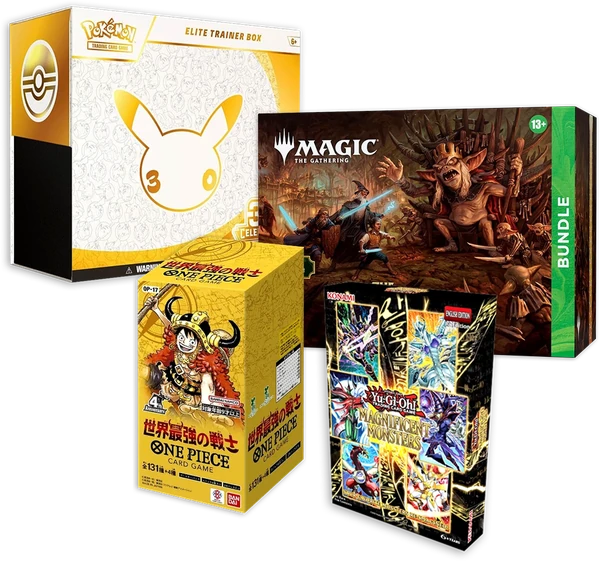


Use Japanese-size sleeves for Yu-Gi-Oh! and standard-size sleeves for Pokémon, Magic: The Gathering, One Piece and Disney Lorcana. Always check the sleeve manufacturer's compatibility information before ordering, especially if you plan to use additional sleeve layers.
“Japanese” describes a common size category. It does not mean that every card printed in Japanese needs a smaller sleeve. Choose for the game and physical card, not the language or country of origin.
For help choosing sizes, finishes and quantities, read our custom card sleeve design and buying guide.
Standard and Japanese sleeves protect different card formats
Standard-size trading cards are generally larger than the cards used in Yu-Gi-Oh!. Sleeve manufacturers offer corresponding product categories, with room around the card for insertion and handling.
As a manufacturer reference, Dragon Shield describes its standard sleeves as accommodating cards up to 63 × 88 mm and its Japanese sleeves as accommodating cards up to 59 × 86 mm. Those are stated card-fit limits, not the external dimensions of every sleeve sold under those category names.
The physical sleeve must be larger than the card it contains. A product listing may show either its external sleeve measurements or the card dimensions it is designed to fit. Check which measurement you are reading before comparing products.
Which sleeve category does each game use?
| Game | Category to choose | Important distinction |
|---|---|---|
| Yu-Gi-Oh! | Japanese | Look for explicit Yu-Gi-Oh! compatibility |
| Cardfight!! Vanguard | Japanese | Check the specific sleeve's compatibility information |
| Pokémon | Standard | Japanese-language Pokémon cards still use the standard category |
| Magic: The Gathering | Standard | Check additional requirements for your format and card types separately |
| One Piece Card Game | Standard | The game's Japanese origin does not make its cards Japanese-size |
| Disney Lorcana | Standard | Choose sleeves intended for standard-size trading cards |
| Flesh and Blood | Standard | Check fit if combining regular and inner sleeves |
This table addresses ordinary game cards. Oversized promotional cards, unusual accessories and other non-standard items need their own measurements.
Do not assume every game absent from the table uses one of these two categories. Board games and collectible products can have other card sizes. Measure unfamiliar cards and compare them with the manufacturer's stated fit range.
Does the card's language affect sleeve size?
Choose sleeves by the card's physical format, not the language of its text. The name “Japanese-size” is an accessory category, not a translation label.
A Japanese-language Pokémon card belongs in the standard category. One Piece also uses standard-size sleeves. Conversely, an English-language Yu-Gi-Oh! card still needs the smaller category intended for that game.
If you are unsure about an unusual edition, check the actual card or its publisher's specifications. Do not order solely from an image, since a photograph without a scale cannot establish dimensions.
Can you put a smaller card in a standard sleeve?
A smaller card may physically enter a larger sleeve, but that does not establish a good fit. Extra space can let it shift inside the sleeve and make the deck feel less controlled when you handle it.
For normal play, start with the sleeve category designed for your game. Do not force a standard-size card into a Japanese-size sleeve. If insertion requires pressure or bends the card, stop and recheck the product.
Size is also separate from tournament acceptability. A sleeve that fits a card is not automatically approved for every event. Check the relevant game and event rules for sleeve consistency, artwork, opacity and additional layers.
Inner, regular and outer sleeves have different jobs
An inner sleeve sits directly around a card before it goes into a regular sleeve. An outer sleeve goes over the regular sleeve, often to help protect its printed back.
These labels describe different positions in the setup. Two products sharing a size category are not automatically interchangeable or guaranteed to fit inside one another.
| Sleeve layer | Where it goes | What to check |
|---|---|---|
| Inner sleeve | Directly around the card | Compatibility with both the card and the regular sleeve |
| Regular sleeve | Around the card, or around its inner sleeve | Correct game category, comfortable fit and consistent handling |
| Outer sleeve | Over the regular sleeve | Compatibility with that regular sleeve's external dimensions |
Test a few cards before preparing the whole deck. The combination should fit without force. Additional layers increase the thickness of the stack, so check your storage and handling as well as the individual fit.
Before adding layers for organized play, read the applicable event instructions. Do not assume a permitted setup in one game or event is permitted in another.
Recheck deck box capacity after sleeving
A box that holds a bare deck may not hold the same cards once sleeved. Inner sleeves, regular sleeves, outer sleeves, dividers and other contents all take space.
Look for capacity information that describes the sleeving setup used. A claim based on single-sleeved cards does not establish capacity for a thicker combination.
Check that the lid closes comfortably and that you can remove the cards without bending them. Avoid forcing a stack into a tight compartment. Browse the deck box collection with your complete setup in mind.
Choosing a size for custom sleeves
The LDB Duel custom sleeve designer offers Standard and Japanese size selections. Choose the size for your cards before finalizing the finish, quantity and artwork placement.
Check the preview after changing the size or border option. A composition prepared for one layout may need repositioning in another. Sleeve fit measurements are not print-template dimensions, so do not use them as a shortcut for setting up artwork.
If you are ordering for more than one game, keep each deck's size requirements clear. Matching artwork does not mean the same sleeve size will suit every deck.
Check these details before ordering
- Identify the game and check its sleeve category.
- Confirm whether listed measurements describe the card or the sleeve.
- Check compatibility with any inner or outer sleeves.
- Test the full combination without forcing the card.
- Allow enough deck box space for the finished stack.
- Check event requirements separately if you play organized events.
- Choose the correct size before approving custom artwork placement.
Once you know the category, compare the card sleeve collection or open the custom sleeve designer to build your own set.


